> ## Documentation Index
> Fetch the complete documentation index at: https://docs.pickcel.com/llms.txt
> Use this file to discover all available pages before exploring further.
# How to Schedule Screen Sleep on Android Devices?
> Schedule automatic screen sleep on Android digital signage players using a Pickcel device profile and the Pickcel launcher, so displays switch off during closed hours and wake up on their own.
On Android players, screen sleep is scheduled from the Pickcel console using a **device profile**, a set of device-level settings you configure once and assign to one or many screens. Set the sleep hours in the profile and every Android screen using that profile goes to sleep and wakes up automatically, saving power and extending panel life during hours when nobody is watching.
**The Pickcel launcher must be installed on the Android TV.** The sleep schedule is set in the console, but it is the launcher on the device that actually carries it out. Without the launcher installed, the schedule saves and assigns normally, but nothing happens on the display.
## How screen sleep works on Android
Screen sleep needs two pieces working together:
This is where you define the schedule: sleep start time, sleep end time, and which screens it applies to. It is configuration only, it does not talk to the TV's power controls directly.
The launcher is installed on the device as an **APK**, alongside the Pickcel player app. It reads the schedule from the assigned device profile and enforces it: at the sleep start time it stops the Pickcel app and drives that TV's own sleep controls, and at the sleep end time it wakes the display and brings the app back.
This is why the launcher is not optional. The console has no way to put an Android TV to sleep on its own, and every Android TV brand exposes its power and sleep controls differently, so the launcher is the piece that bridges the two.
Because those controls differ from model to model, **installing the launcher is specific to each Android TV**. That process is covered in its own guide, separate from this page. Install the launcher on your TV first, then come back and set the schedule below.
## Set up the sleep schedule
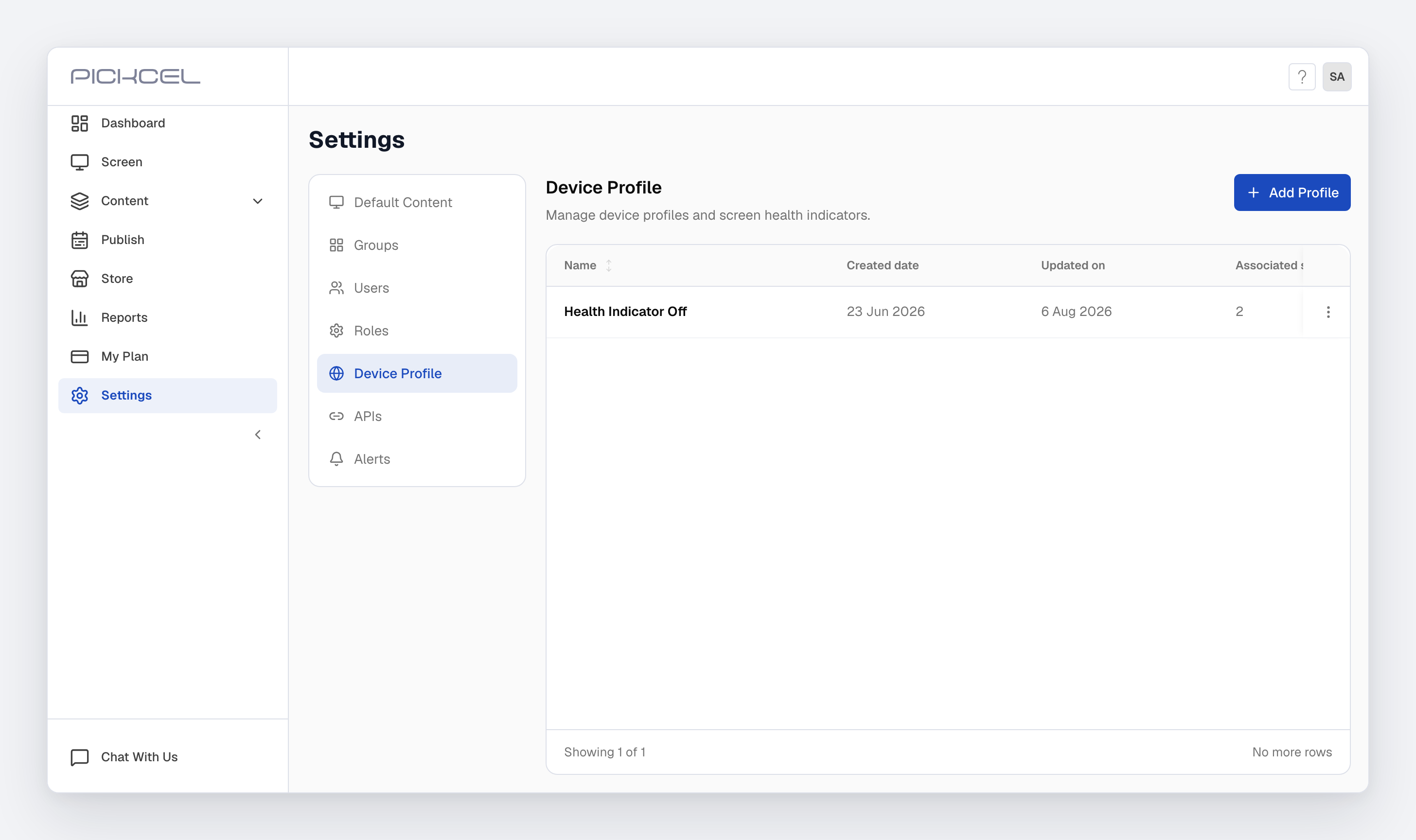
In the Pickcel console, go to the **Settings** module and open the **Device Profile** tab. Click **Add Profile** in the top-right corner.
Already have a profile assigned to these screens? Click its **three-dot (...)** menu and choose **Edit** instead of creating a new one. A screen can only use one device profile at a time.
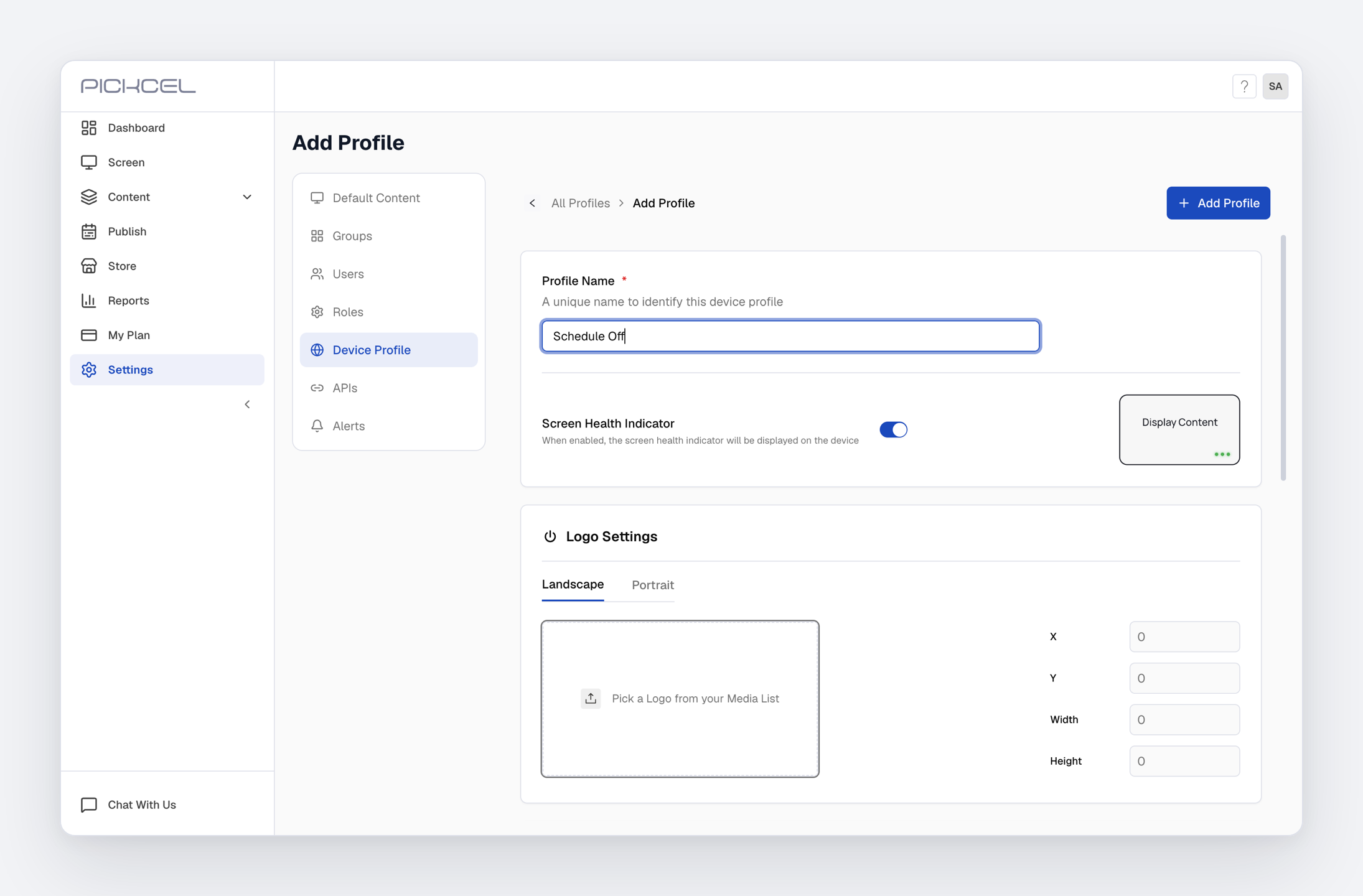
 Enter a unique **Profile Name** so you can identify the profile later, for example "Schedule Off".
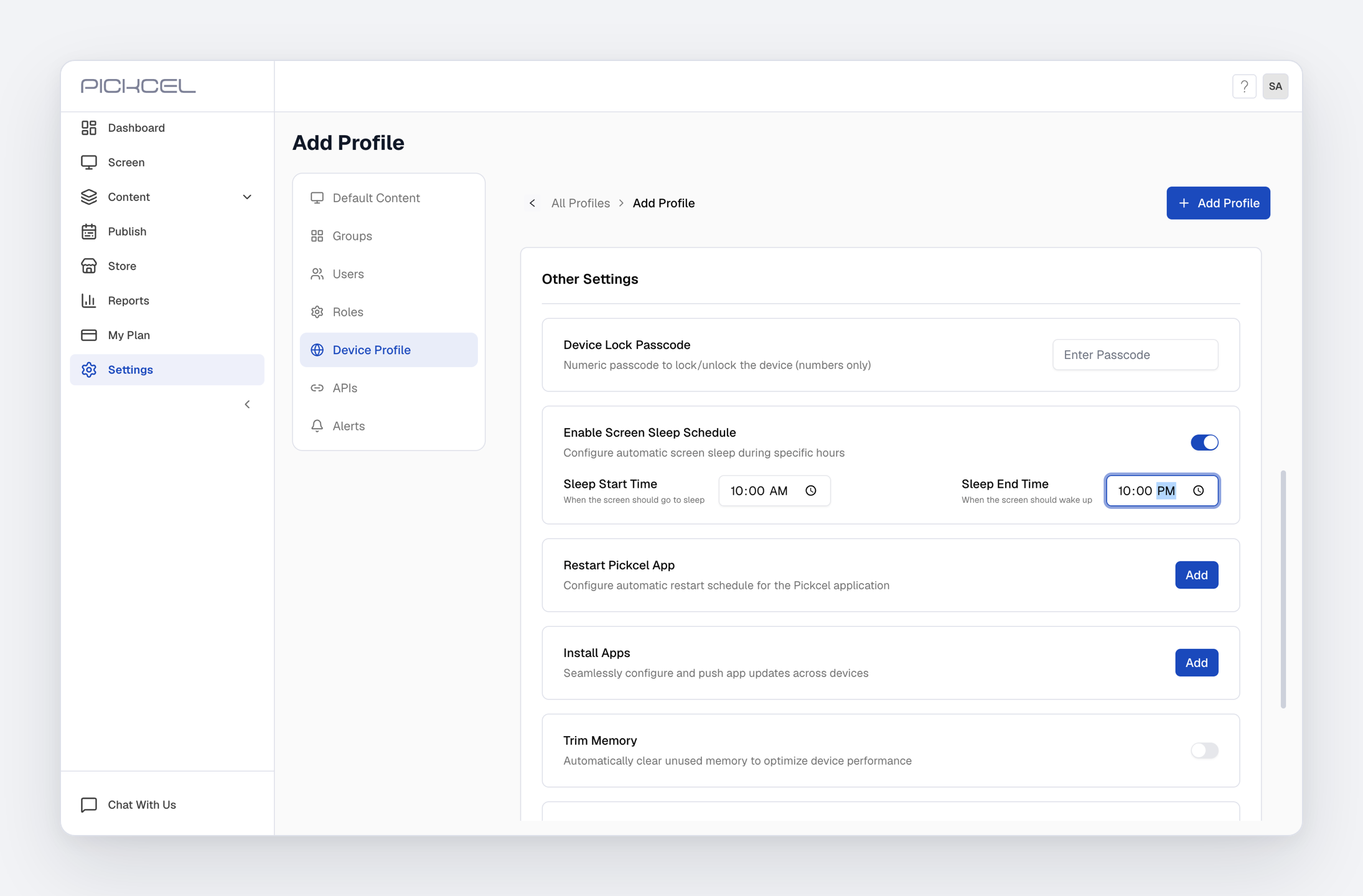
 Scroll past **Logo Settings** to the **Other Settings** panel and switch **Enable Screen Sleep Schedule** on. Two time fields appear:
* **Sleep Start Time**: when the screen should go to sleep.
* **Sleep End Time**: when the screen should wake up.
Set both using the clock picker.
Scroll past **Logo Settings** to the **Other Settings** panel and switch **Enable Screen Sleep Schedule** on. Two time fields appear:
* **Sleep Start Time**: when the screen should go to sleep.
* **Sleep End Time**: when the screen should wake up.
Set both using the clock picker.
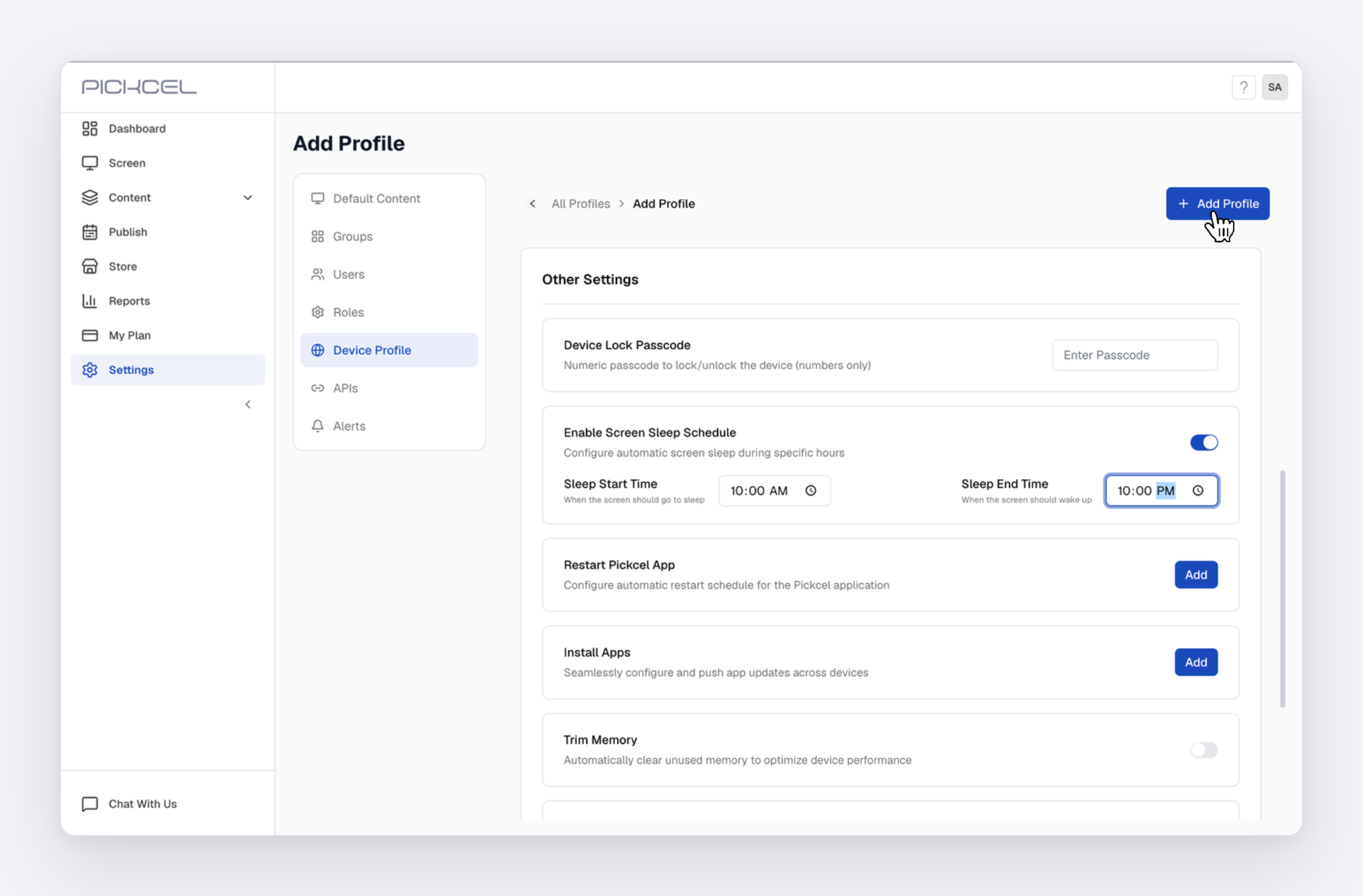
 Click **Add Profile** in the top-right corner to save.
 A **Profile created successfully** message appears and the new profile shows up in the Device Profile list with **0** associated screens for now.
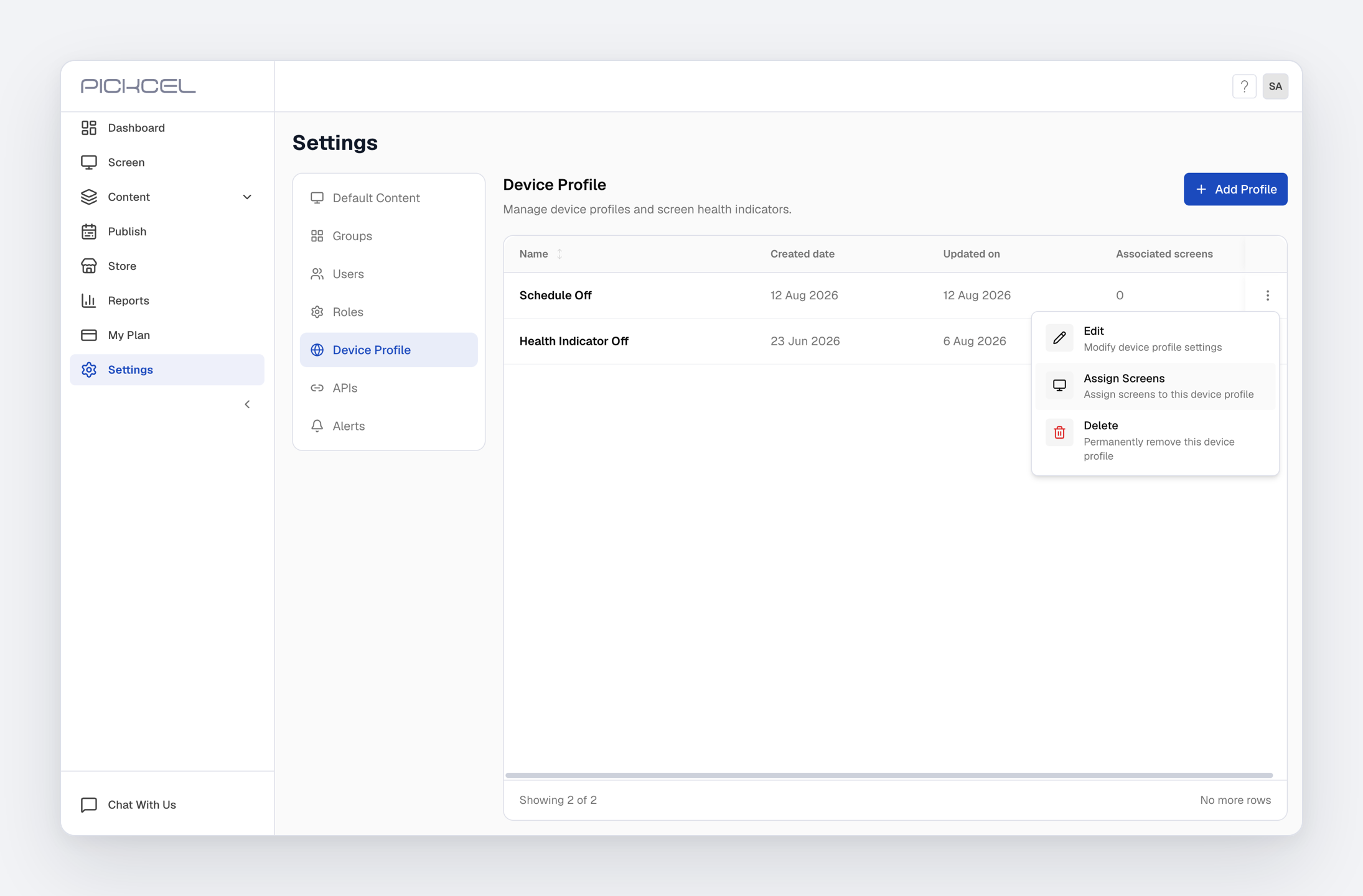
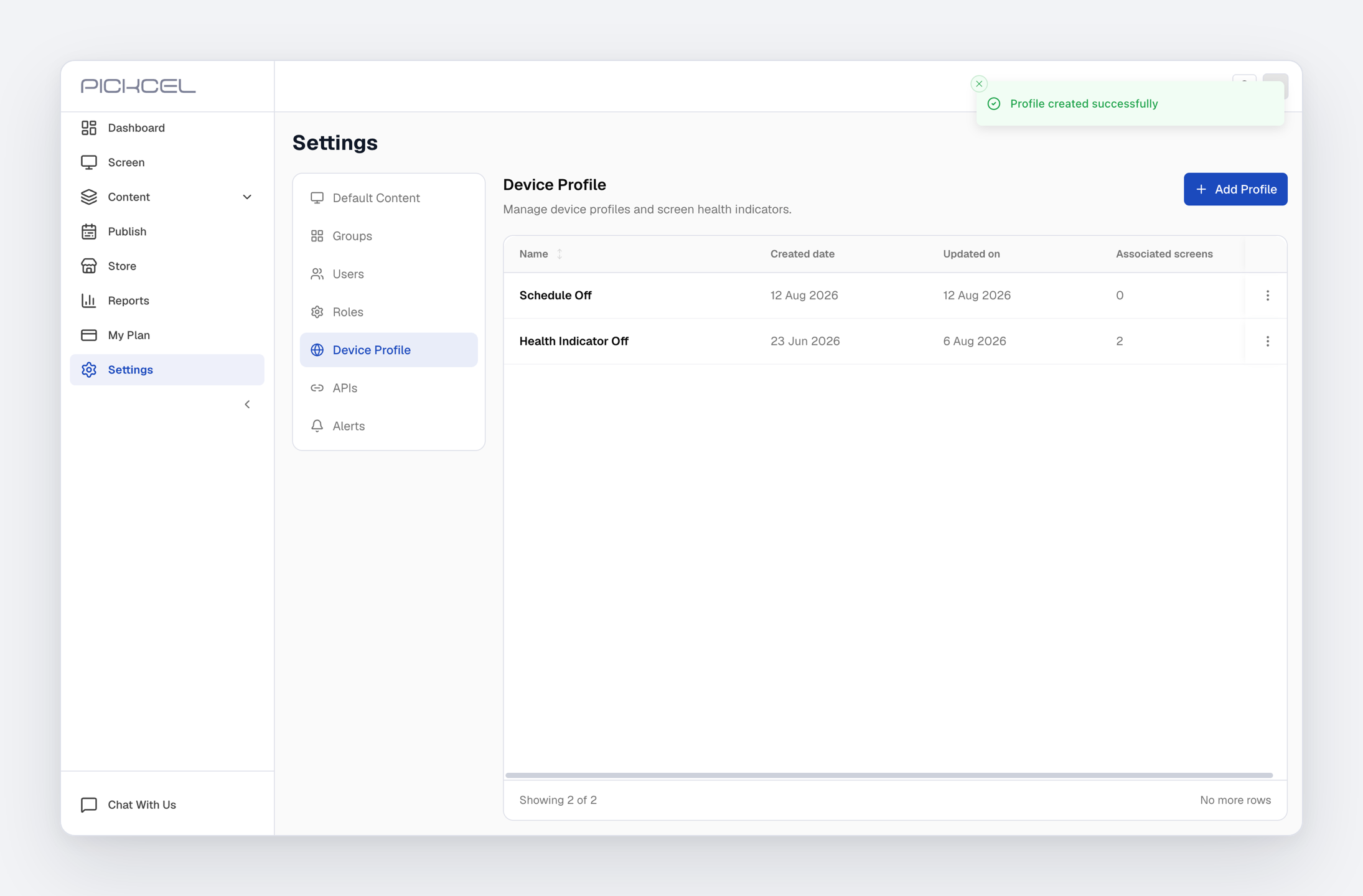 The schedule only takes effect once the profile is applied to a screen. Click the **three-dot (...)** menu on the right of the profile row and choose **Assign Screens**.
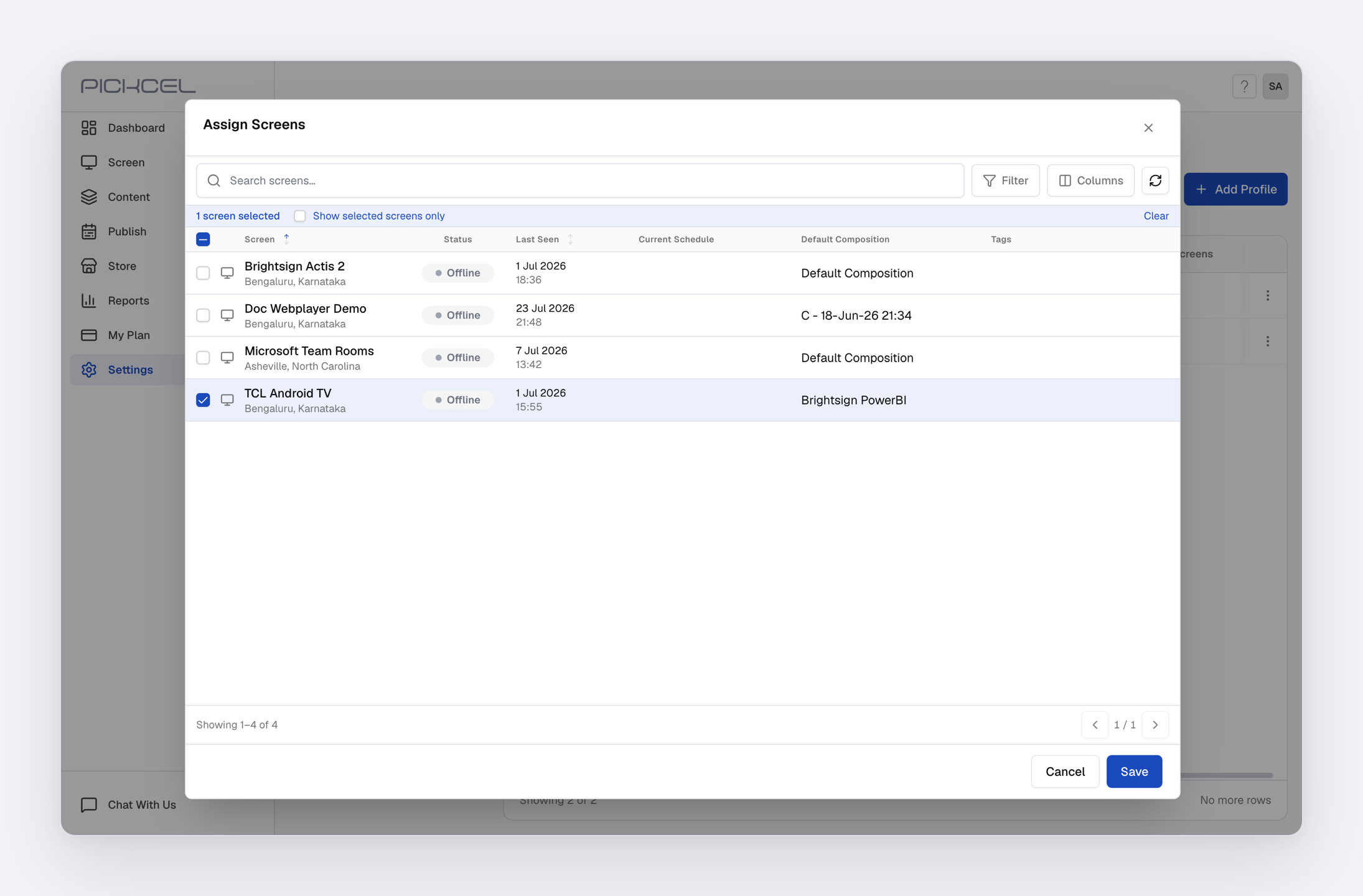
 In the **Assign Screens** dialog, tick the Android screens that should follow this sleep schedule, then click **Save**. Use **Search screens...** to find specific screens, and the counter at the top left confirms how many are selected.
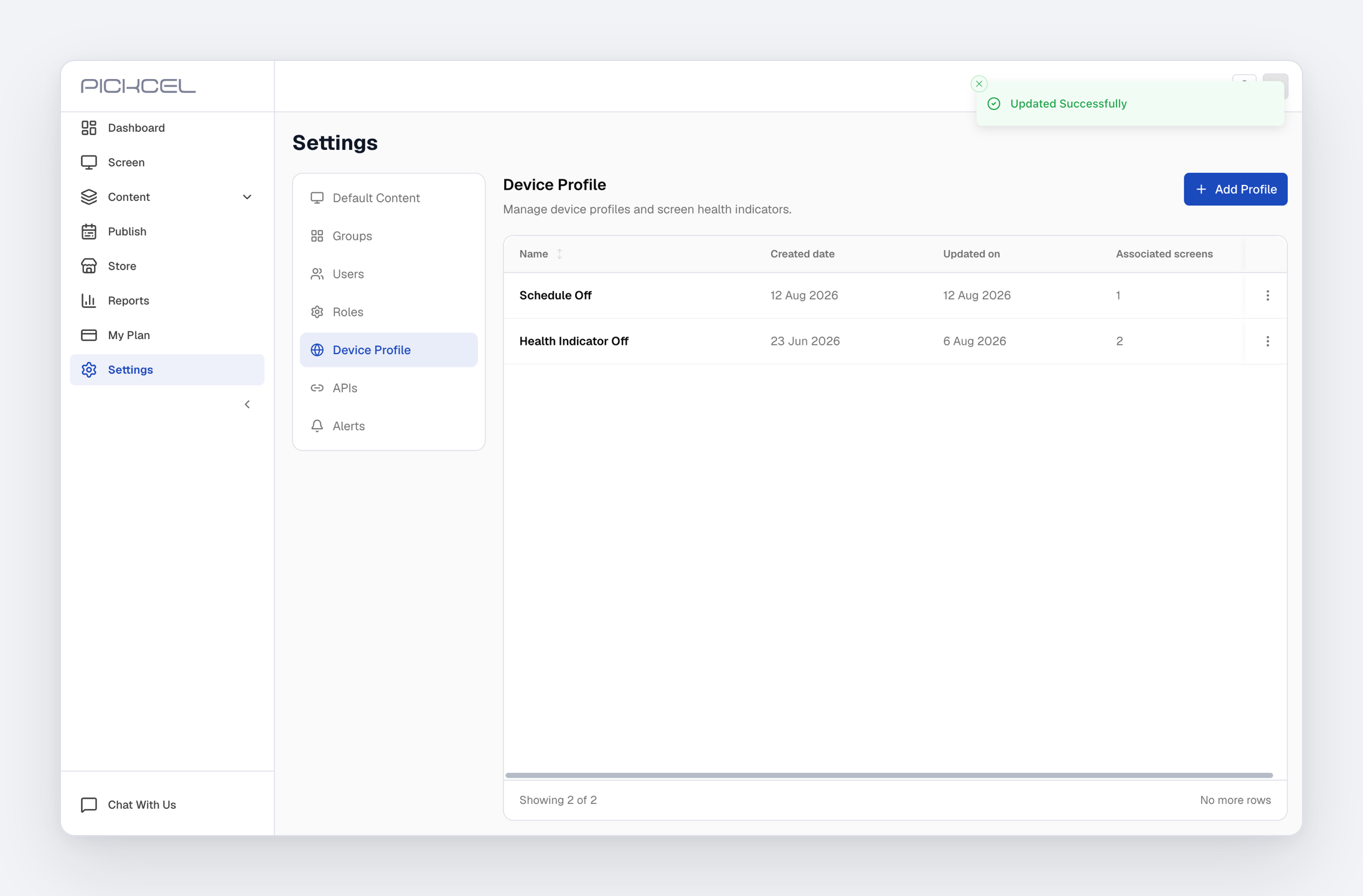
 You'll see an **Updated Successfully** message, and the **Associated screens** count for the profile now reflects the screens you picked.
 Your Android screens will now go to sleep and wake up automatically at the times you set.
## Good to know
Check these in order:
1. **The Pickcel launcher is installed on the TV.** This is the most common cause. The console accepts and saves the schedule whether or not the launcher is present, so a correctly configured profile still does nothing on a device without it.
2. The profile is actually **assigned** to that screen. The Device Profile list shows the associated screen count.
3. The screen has picked up the new profile. If in doubt, force it to re-fetch, see the next question.
4. The device's **date and time are correct**. A device with a wrong clock sleeps at the wrong time. The third [health indicator dot](/faqs/health-indicators) turns red when the device's date/time is off.
5. The player is **online**, so it can receive the updated profile.
Still stuck? Contact our [support team](mailto:support@pickcel.com).
If a screen is assigned to the profile but is not sleeping, make it re-fetch its settings:
* **Restart the screen**: switch the display off and then on again.
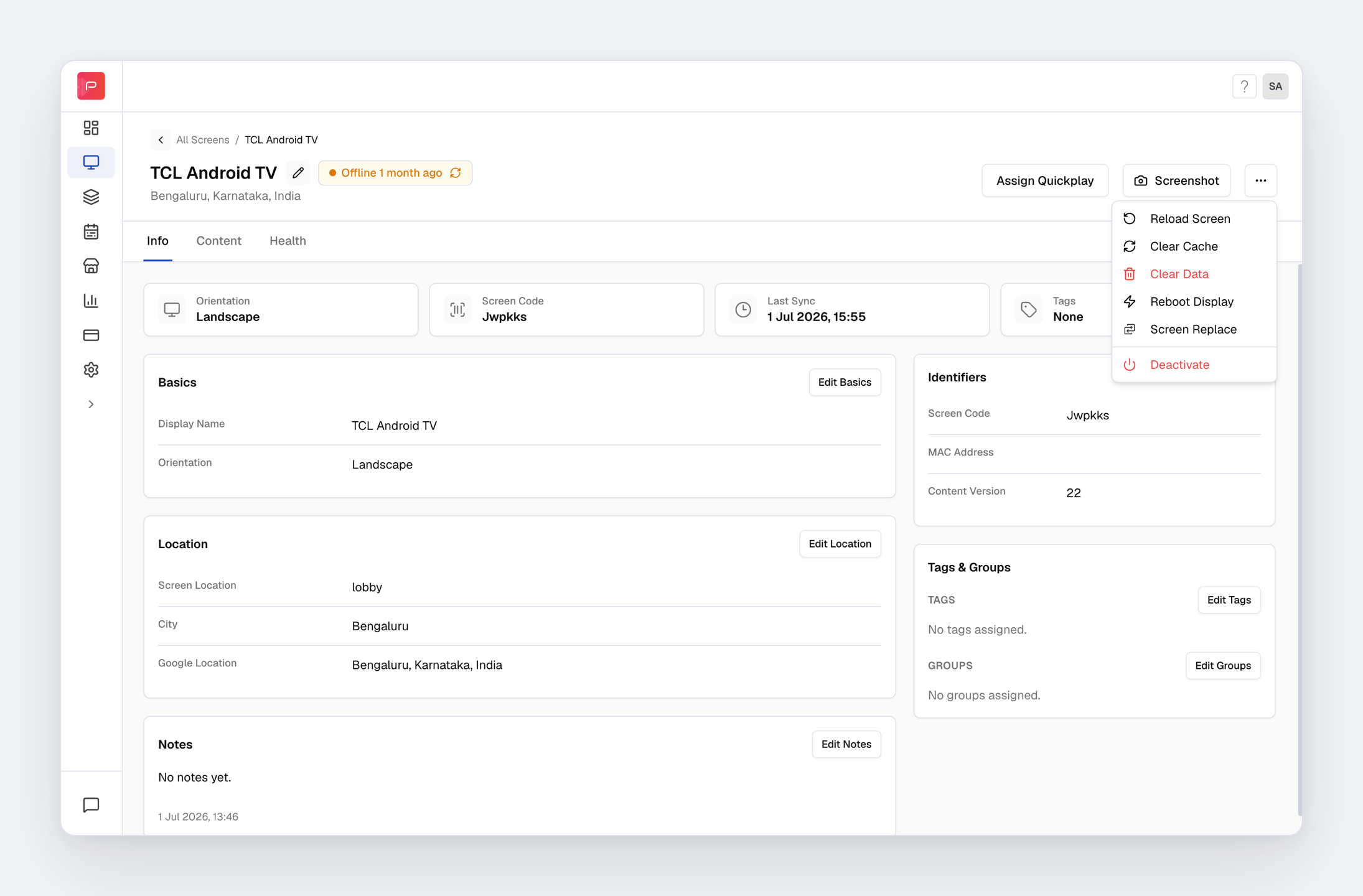
* **Clear the cache from the console**: open the **Screen** module, click the screen to open its details, click the **three-dot (...)** menu at the top right, and choose **Clear Cache**. This re-fetches the latest settings and reloads the screen.
In that same menu, **Clear Data** and **Deactivate** are destructive. **Clear Cache** is the one you want here.
Your Android screens will now go to sleep and wake up automatically at the times you set.
## Good to know
Check these in order:
1. **The Pickcel launcher is installed on the TV.** This is the most common cause. The console accepts and saves the schedule whether or not the launcher is present, so a correctly configured profile still does nothing on a device without it.
2. The profile is actually **assigned** to that screen. The Device Profile list shows the associated screen count.
3. The screen has picked up the new profile. If in doubt, force it to re-fetch, see the next question.
4. The device's **date and time are correct**. A device with a wrong clock sleeps at the wrong time. The third [health indicator dot](/faqs/health-indicators) turns red when the device's date/time is off.
5. The player is **online**, so it can receive the updated profile.
Still stuck? Contact our [support team](mailto:support@pickcel.com).
If a screen is assigned to the profile but is not sleeping, make it re-fetch its settings:
* **Restart the screen**: switch the display off and then on again.
* **Clear the cache from the console**: open the **Screen** module, click the screen to open its details, click the **three-dot (...)** menu at the top right, and choose **Clear Cache**. This re-fetches the latest settings and reloads the screen.
In that same menu, **Clear Data** and **Deactivate** are destructive. **Clear Cache** is the one you want here.
 Go to **Settings → Device Profile**, click the profile's **three-dot (...)** menu, and choose **Edit**. Adjust the times, or switch **Enable Screen Sleep Schedule** off to stop sleeping the screens entirely. Save, then refresh the screens (restart or clear cache) so the change reaches the device.
**Hard Sleep** is a separate toggle in the same **Other Settings** panel. Where the standard sleep schedule blanks the display, Hard Sleep forces a complete system sleep mode for maximum power savings. Leave it off unless you specifically need the deeper power saving, and test it on one screen first, since waking behavior varies by device.
Yes, that is the point of a device profile. Assign the one profile to every screen that shares the same sleep hours. If different locations need different hours, create one profile per schedule and assign each to its own set of screens.
## Related Articles
Install the Pickcel player app on your Android device
All the device-level settings you can configure in a profile
Register and configure your Android display in the console
Browse more troubleshooting guides and FAQs
Go to **Settings → Device Profile**, click the profile's **three-dot (...)** menu, and choose **Edit**. Adjust the times, or switch **Enable Screen Sleep Schedule** off to stop sleeping the screens entirely. Save, then refresh the screens (restart or clear cache) so the change reaches the device.
**Hard Sleep** is a separate toggle in the same **Other Settings** panel. Where the standard sleep schedule blanks the display, Hard Sleep forces a complete system sleep mode for maximum power savings. Leave it off unless you specifically need the deeper power saving, and test it on one screen first, since waking behavior varies by device.
Yes, that is the point of a device profile. Assign the one profile to every screen that shares the same sleep hours. If different locations need different hours, create one profile per schedule and assign each to its own set of screens.
## Related Articles
Install the Pickcel player app on your Android device
All the device-level settings you can configure in a profile
Register and configure your Android display in the console
Browse more troubleshooting guides and FAQs